Using Aprimo with Glean
Agentic orchestration is one of the fastest-moving areas in enterprise software. Aprimo is actively investing in integrations, tooling, and guidance for platforms like Glean. The patterns and approaches documented here reflect our current best understanding — check back regularly as this space develops. Have a use case or question not covered here? Reach out to your Aprimo Customer Success Manager and we will work with you to understand your use case.
Glean is an enterprise AI platform that connects knowledge from across an organization's tools and surfaces it through search, chat, and agents. This article covers how Aprimo connects into Glean — first by explaining Glean's extensibility model, then by mapping the Aprimo integration patterns to it.
Understanding Glean's Extensibility Model
Before building an integration, it helps to understand how Glean is structured and where external systems plug in. Glean exposes four primary extensibility points.
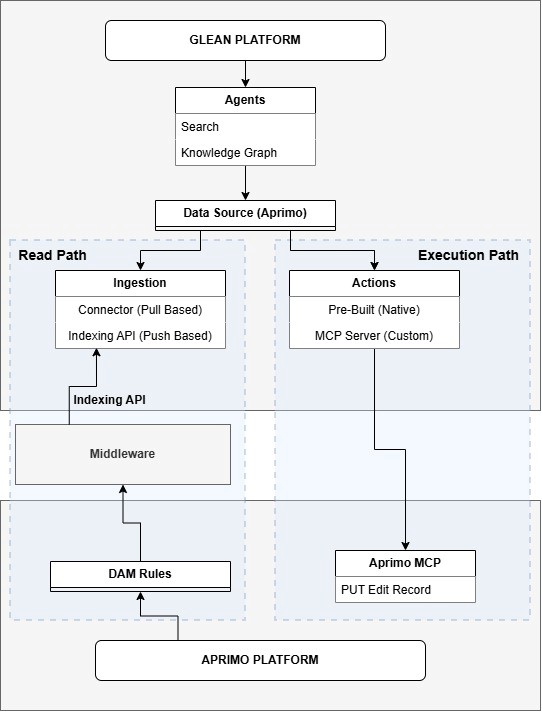
Data Sources and Indexing
A Data Source is Glean's representation of an external system. It organizes the content, permissions, and actions from that system so they can be searched and interacted with consistently inside Glean.
Content gets into a Data Source through one of two mechanisms:
- Connectors — a pull-based approach where Glean retrieves content from the external system.
- Indexing API — a push-based approach where the external system sends content into Glean.
Data Source
├── Pull → Pre-built Connectors (Glean crawls)
└── Push → Indexing API
           ├── Direct API calls (your middleware, DAM Rules, etc.)
           └── Custom Connector (packaged push code, Glean or self-hosted)
Connectors
Aprimo is actively investigating both a pre-built Connector (Glean crawls Aprimo on a schedule) and a Custom Connector (a packaged push deployment hosted by Glean or self-hosted). Until a connector is available, the recommended approach is direct Indexing API integration triggered by Aprimo DAM Rules.
Connectors are Glean's pull-based mechanism — Glean crawls the external system on a schedule and ingests content into the Data Source. Glean provides 80+ pre-built connectors for common enterprise systems. For systems without one, custom connectors can be built and packaged as Docker containers, then hosted on Glean's infrastructure or your own. See the Glean custom connectors documentation for details.
Indexing API
The Indexing API is the push alternative — your system sends documents directly to Glean via HTTP. Each document requires a stable id, title, searchable body, a viewUrl (the click-through link rendered in search results), and a permissions object controlling visibility. The viewUrl must match the URL pattern registered on the Data Source.
The Indexing API exposes two key endpoints:
POST /api/index/v1/indexdocument— add or update a single documentPOST /api/index/v1/bulkindexdocuments— replace documents in bulk via paginated batches
Once indexed, documents in a Data Source are searchable by Glean's search layer and accessible to Glean Agents.
Glean Search
Glean Search is the retrieval layer over Glean's knowledge graph. It surfaces relevant content across all connected Data Sources, taking into account context, permissions, and relationships between documents. Agents use Glean Search as their primary tool for finding information before reasoning or responding.
Actions
Actions are the mechanism by which Glean agents affect external systems. They are configured in the Glean Admin console and work by making HTTP requests to an external API when a user's message matches the action's trigger condition. Each action defines the endpoint, request shape, authentication, and field-level type hints that help the LLM populate values correctly. Actions support OAuth (admin-level or per-user) and JWT-based request verification.
For Aprimo, an Action would call the Aprimo REST API — for example, updating record metadata or changing a record's status — as part of a Glean agent workflow. See the Glean Actions documentation for configuration details.
MCP Servers
Glean is building support for MCP-backed Actions — where instead of defining a raw HTTP endpoint, an Action is backed by an MCP server that exposes a set of callable tools. When available, this would allow a Glean agent to invoke the Aprimo MCP Server as an action, discovering and calling Aprimo tools without requiring each API call to be manually defined in the Admin console.
Today:    Glean agent → Action (HTTP) → Aprimo REST API
Future:   Glean agent → Action (MCP)  → Aprimo MCP Server → Aprimo
Glean has announced MCP-backed Actions but has not yet released the feature. Aprimo is monitoring this development. See Glean's documentation for current status.
Glean Agents
Agents are Glean's native execution layer. They orchestrate search and actions across connected Data Sources to retrieve information and trigger workflows in response to user requests. Agents have access to all configured Data Sources, Actions, and MCP Servers within the Glean environment.
Example Architecture